The Institute Chronicle serves as an ongoing record of exhibitions, collections, research, discoveries, publications, lectures, and activities associated with the Think Potato Institute. Entries range from contemporary projects and institutional milestones to archival discoveries, collection highlights, historical documentation, field observations, and examples of POTATOPHENA encountered in everyday life. Together they document more than three decades of potato-related art, research, collecting, and public engagement.
Author: Jeffrey Allen Price
-
Stephen Mehler Thinks Potato
Less than a month after returning from our two-week tour of Egypt, my friend and mentor Stephen Mehler shared this photograph and kind message on Facebook. His post sums up the experience beautifully, and I am honored to see him proudly wearing a THINK POTATO shirt.
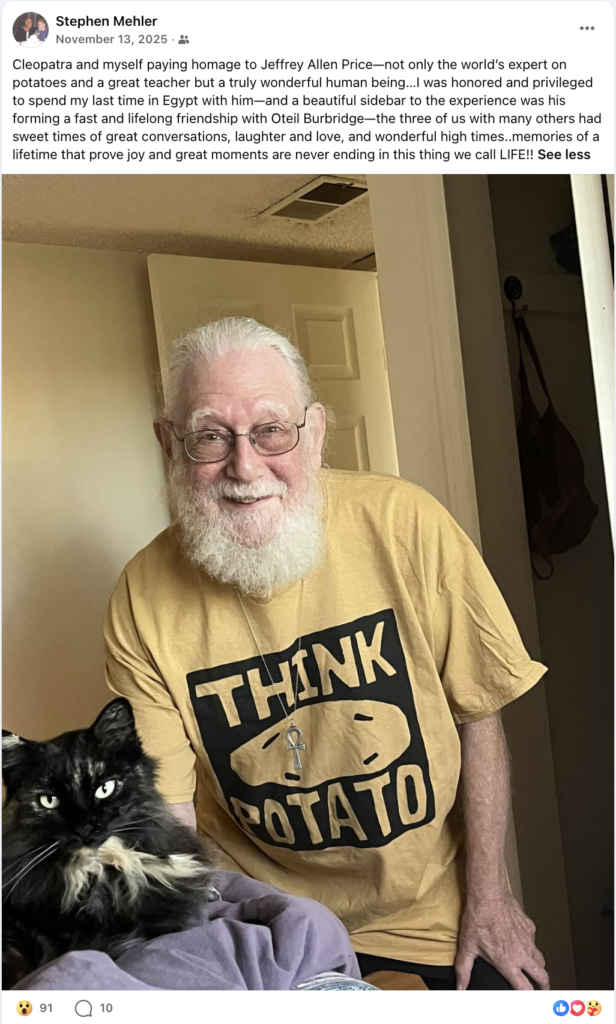
Thank you, Stephen. The feeling is mutual.
-
THINK POTATO BANDIT
Mobile Register, 2005
18 years ago Jesse Lee Arnold was going around Alabama robbing banks wearing one of my classic Think Potato T-Shirts. He was eventually caught and served 12 years in prison. This bank security camera photo was sent to me by The Mobile Register (they even called to interview me about this! Ha ha ha).
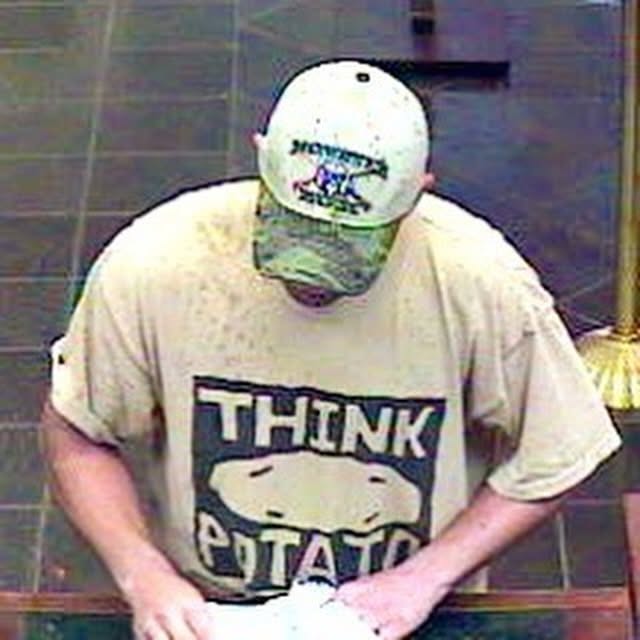
Jesse Lee Arnold robbing banks in Alabama wearing my THINK POTATO T-shirt design.
Photo courtesy of the Mobile Register, 2005. -
Revisiting The Dialectical Potato
While recently preparing a lecture for the United By Potato Power conference in Cēsis, Latvia, I returned to a paper I had not carefully revisited in many years: The Dialectical Potato: Potato in Art, Art in Potato.
Originally published in 2003 by Donald Kuspit, the essay was written while I was completing graduate school at Stony Brook University. At the time, I regarded it primarily as an art historical investigation into the appearance of potatoes within art and culture.
Reading the paper again more than twenty years later was a satisfying experience.
What I found was not simply an early survey of potato imagery, but the beginnings of ideas that would later become central to my work. Concepts now associated with POTATOISM, Potato Humanities, the Potato Art Spectrum, and the Think Potato Institute were already present in embryonic form throughout the text.
I was particularly struck by how many of the questions that continue to guide my research today were already visible in those pages. Why does the potato repeatedly emerge as a symbolic object across cultures and historical periods? How can a humble food become a vehicle for mythology, identity, labor, humor, ritual, politics, and artistic expression? Why does the potato seem uniquely capable of sustaining contradictory meanings simultaneously?
What appeared in 2003 as a graduate school paper now felt more like a foundational document.Revisiting The Dialectical Potato also made me realize that the project remains unfinished. Since its publication, more than two decades of new potato artworks, exhibitions, performances, films, photographs, and cultural artifacts have emerged, while countless historical examples have come to light that I was unaware of at the time. What once appeared to be a finished paper now feels more like the opening chapter of a much larger project—one that I hope to continue through a future publication, POTATOISM: The Global History of Potato Art.
Related Timeline Entry:
→ The Dialectical Potato: Potato in Art, Art in Potato, 2003
Related Documentation:
→ Institute Chronicle: The Dialectical Potato Accepted for Publication
-
Parmentier Would Have Approved
On March 1, 2024, a four-course gourmet potato dinner (Kartupelis Gardēdim / Potato for Gourmets) was held at Michelin-star restaurant H.E. Vanadziņš Ziemeļu restorāns as part of the United By Potato Power events in Cēsis, Latvia.
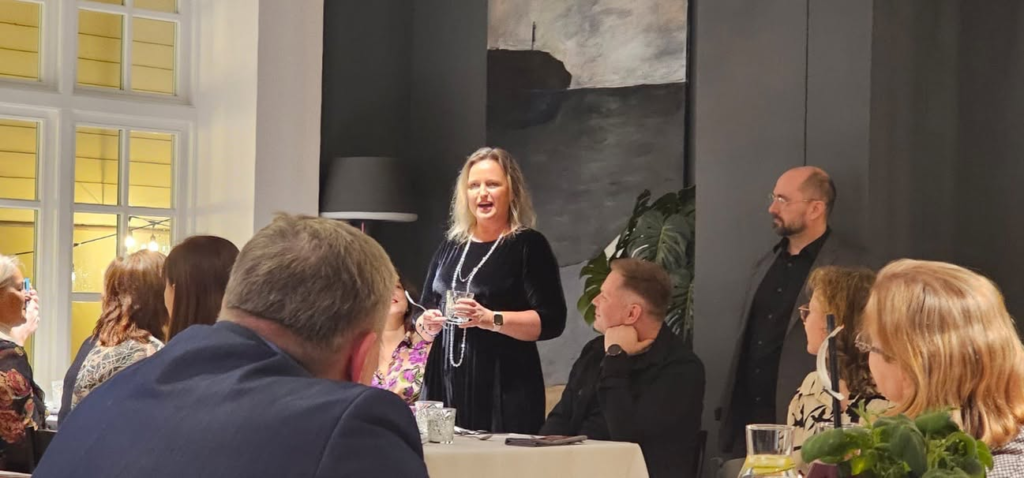
Sigita Kletniece welcoming diners and introducing Jeffrey Allen Price I can unequivocally state that this was one of the greatest meals of my life so far, and I am grateful to chef Edgars Rubenis for living up to the challenge of creating a potato-themed haute cuisine dining experience. The chef came out after every course and explained how he had used potatoes in his delectable creations (at least eight local varieties). I believe the diners in attendance were quite impressed and satiated, but I was beyond satisfied—rather in awe and ecstasy!
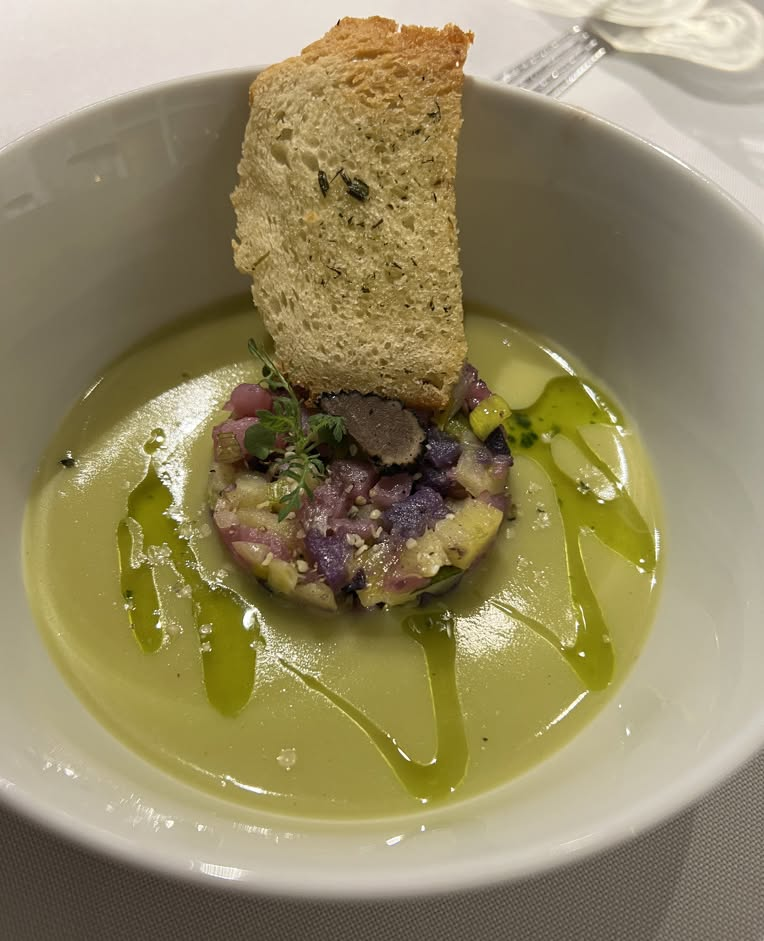
First Course: Potato / meadow cranberry (Vegetarian adaptation).
Photo by Jeffrey Allen Price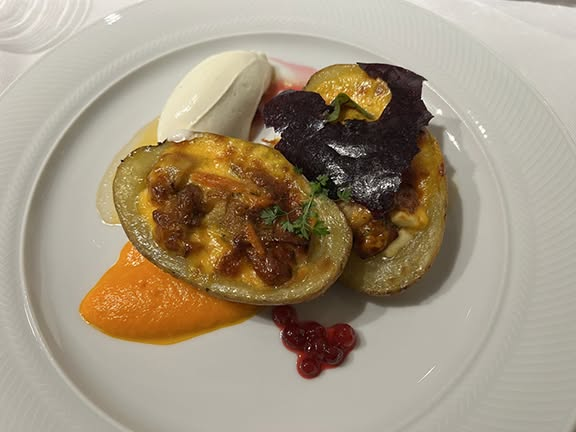
Main Course: Potato / broad beans.(Vegetarian Adaptation).
Photo by Jeffrey Allen Price.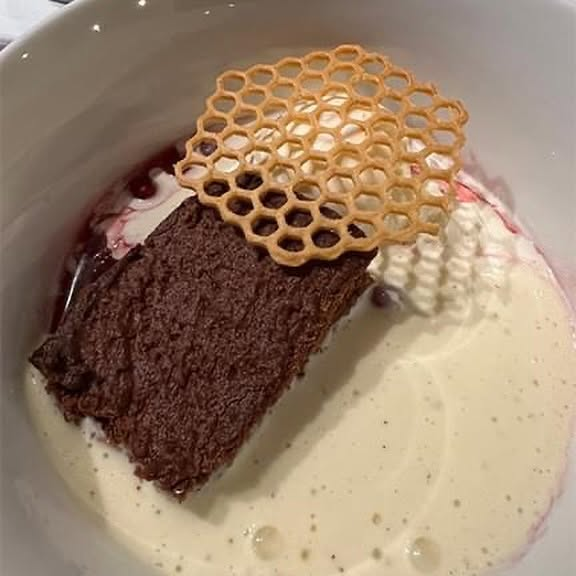
Dessert: Potato / yogurt / chocolate cake. Photo courtesy of Jeffrey Allen Price. When I was invited to participate in the potato conference and related events, I suggested the idea of this dinner, and I am grateful to everyone who enthusiastically embraced the concept and made it a reality. Before the first course was served, I had the honor of welcoming the approximately forty guests in attendance and offering a brief introduction to the evening. I spoke about Antoine-Augustin Parmentier, the eighteenth-century chemist and agronomist whose famous potato dinners inspired the event, and reflected on the remarkable journey of the potato from humble staple crop to the centerpiece of a Michelin-level dining experience.
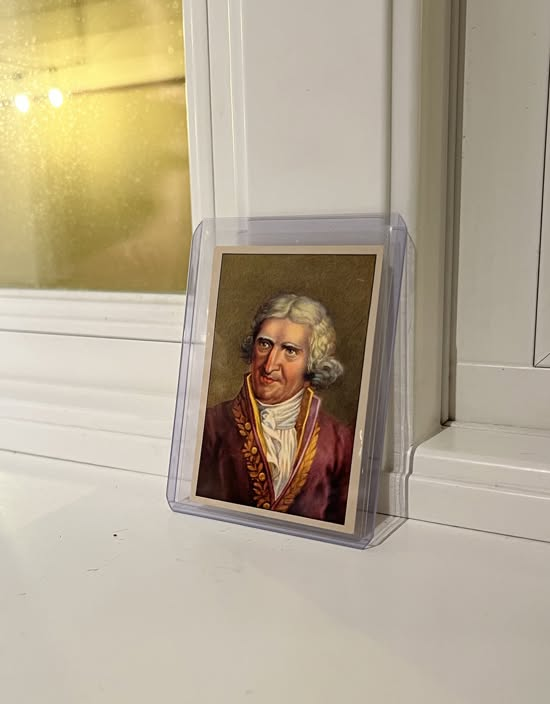
1938 Gutermann Trading Card #19 Antione Parmentier (1737-1813).
Think Potato Institute Permanent Collection. Photo by Jeffrey Allen PriceI installed a small 1938 trading card featuring Parmentier next to our table throughout the evening, ensuring that the evening’s honorary guest was present in spirit.
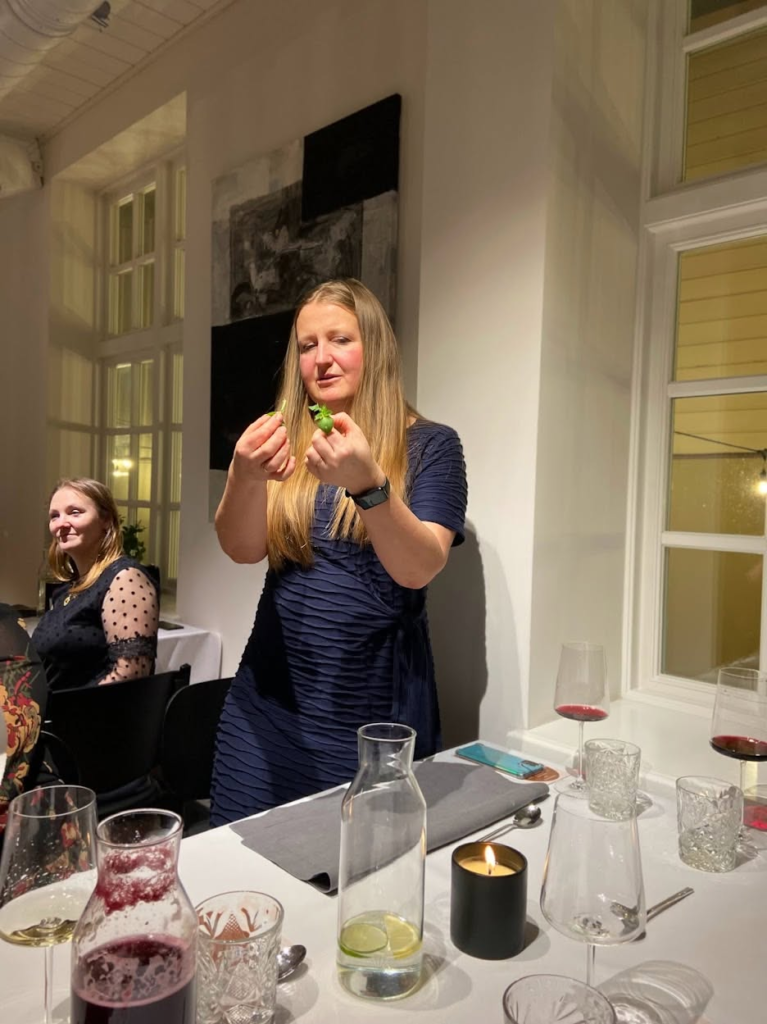
Ilze Dimante speaking at Kartupelis Gardēdim. Photo courtesy of Cesis inside. Between courses, Ilze Dimante spoke about potato cultivation and research, while potato plants decorated every table in the restaurant. The evening beautifully connected science, agriculture, gastronomy, history, and culture through the humble potato.
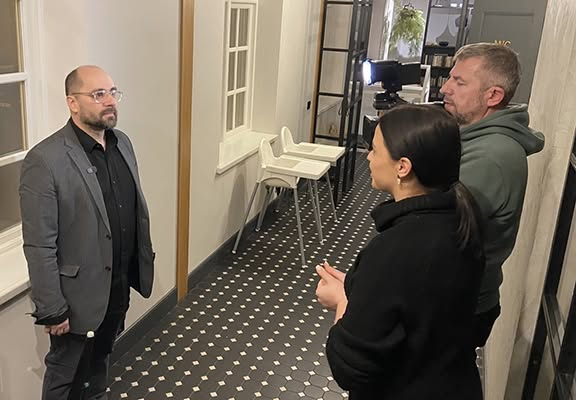
Potato Artist Jeffrey Allen Price interviewed by RETV. Photo courtesy of Sigita Kletniece After the dessert course, I had the opportunity to speak with chef Edgars Rubenis and ask a few questions about his remarkable creations. RETV was also present throughout the evening, interviewing participants and documenting what became one of the most memorable potato events I have ever attended.
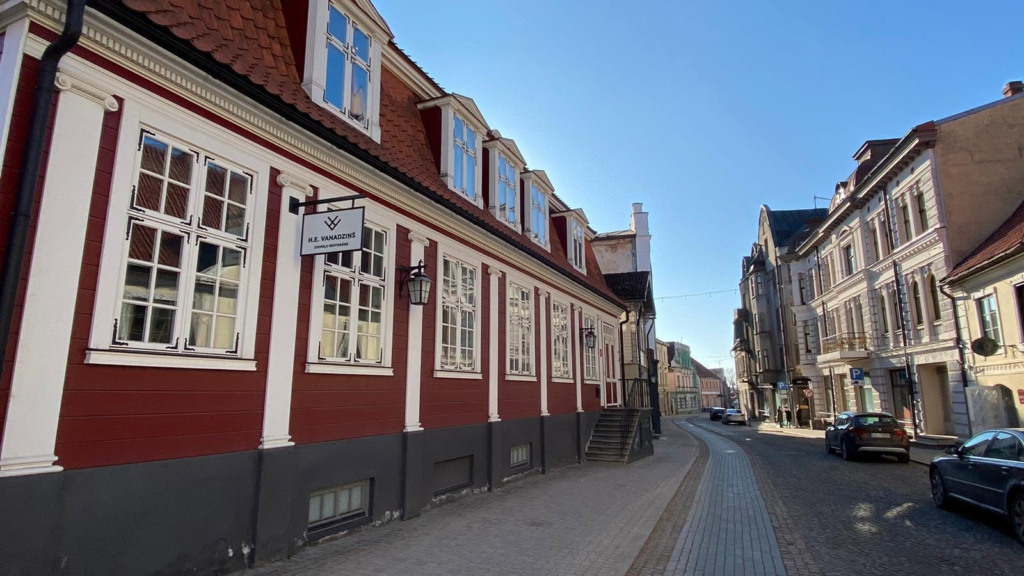
Michelin-star restaurant H.E. Vanadziņš Ziemeļu restorāns. Photo courtesy of Sigita Kletniece This was truly a once-in-a-lifetime potato experience. Congratulations to everyone who helped create it and to everyone fortunate enough to attend.
Related Documentation:
→ Institute Chronicle: From Parmentier to Latvia: Potato for Gourmets on RETV
Related Projects:
→ Kartupelis Gardēdim (Potato for Gourmets) (2024)
→ Open Feast: Potato Potluck (2012)
-
From Parmentier to Latvia: Potato for Gourmets on RETV
A 2024 RETV news segment documented Kartupelis Gardēdim (Potato for Gourmets), a Michelin-level potato dinner conceived by Jeffrey Allen Price and realized with chef Edgars Rubenis in Cēsis, Latvia.
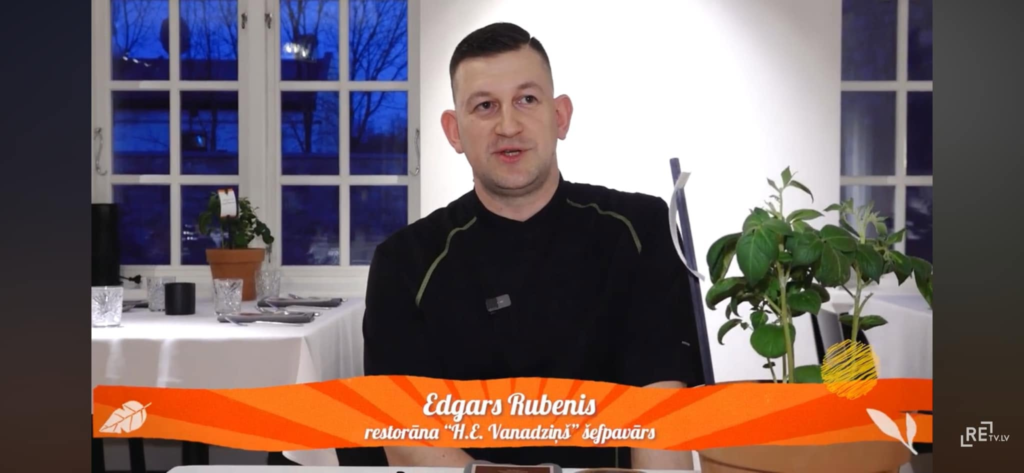
Master Chef Edgars Rubenis on RETV, 2024 There is a really great news story (in Latvian) by RETV about the “Potato for Gourmet” dinner that took place at Michelin Star restaurant H.E. Vanadziņš Ziemeļu restorāns on March 1, 2024. They interviewed the brilliant chef Edgars Rubenis and showed some excellent footage of the meal preparations and some of his finished Potato masterpieces. Includes a lot of images of the Potato plant decorations/accents provided by Ilze Dimante and an interview with Cesis inside director Sigita Kletniece, who enabled the Potato dinner event as liaison and moderator. They even interviewed Potato Artist, Džefrijs Alens Praiss (Jeffrey Allen Price), whose idea for the dinner was the seed that grew into this historic feast — a dining experience that even Parmentier would have been impressed and delighted by.
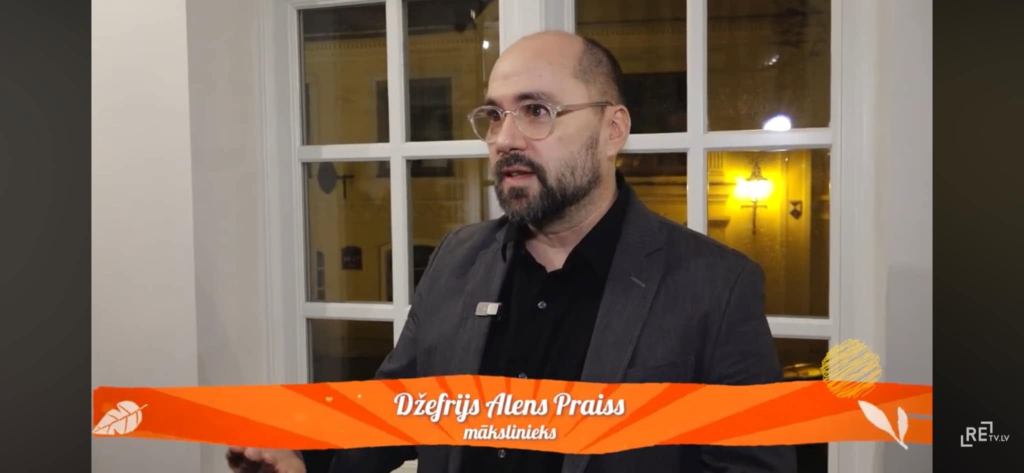
Potato Artist, Džefrijs Alens Praiss (Jeffrey Allen Price) on RETV, 2024
Related Projects:
→ Kartupelis Gardēdim (Potato for Gourmets) (2024)
→ Open Feast: Potato Potluck (2012)
-
Imagine if I was Deranged?
Dear Internet, I made this for you. You’re welcome, love THINK POTATO INSTITUTE.
Just doing my part to proliferate Potato Memes on the web.
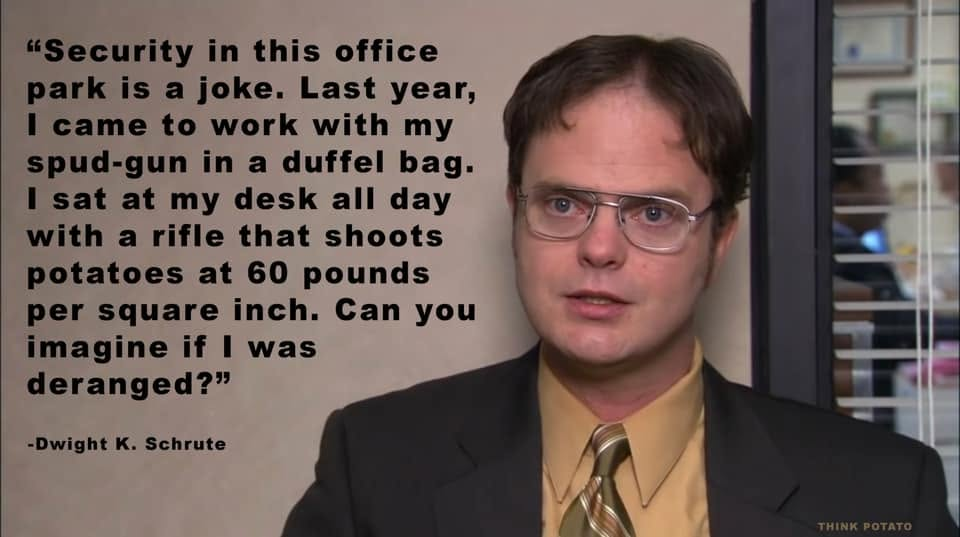
This quote occurs in The Office, Season 2, Episode 21, titled “Conflict Resolution“.
-
We Say Potato At Islip Art Museum
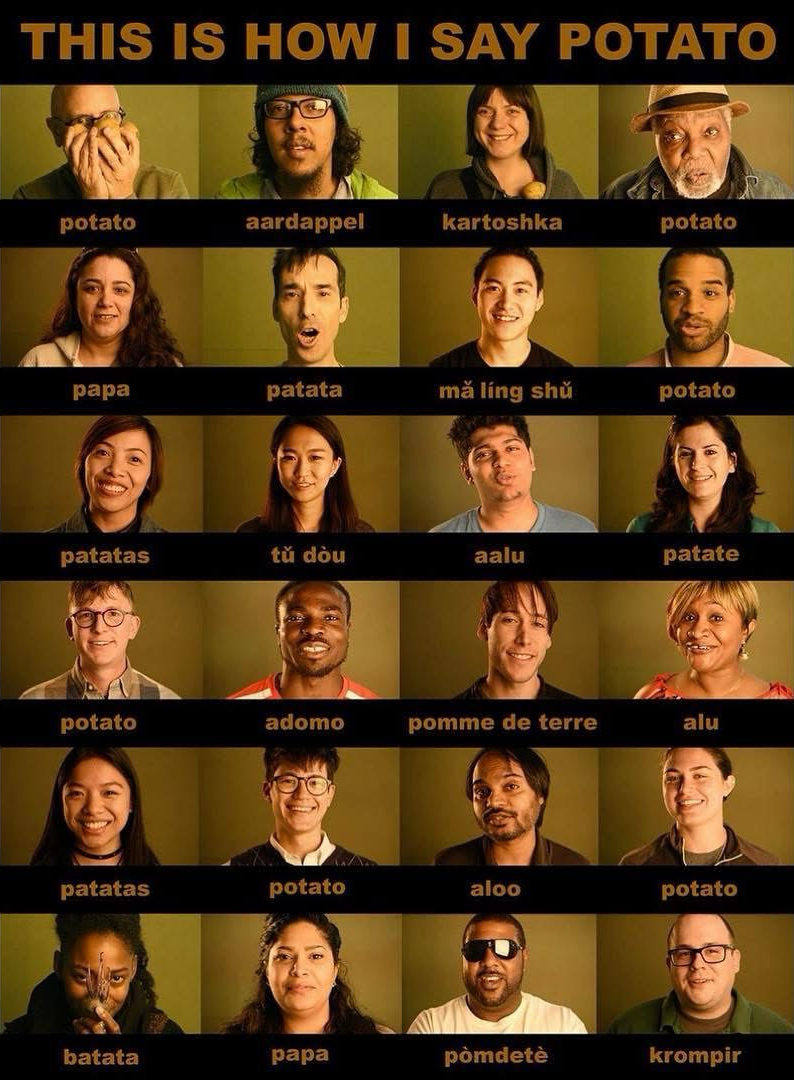
A brand-new version of our film in-progress THIS IS HOW I SAY POTATO, is currently on view at the Islip Art Museum in the exhibition “Collaboration.” There is an Artist Reception, August 3 from 1-3pm. Thank you to my collaborator Juan Lopez Espantaleon for all the great work on this project so far, and for the installation photo. Also, a huge gratitude to the 100+ participants that have given their beautiful faces and unique languages and accents to this project. I hope you some of you can attend the reception Saturday.
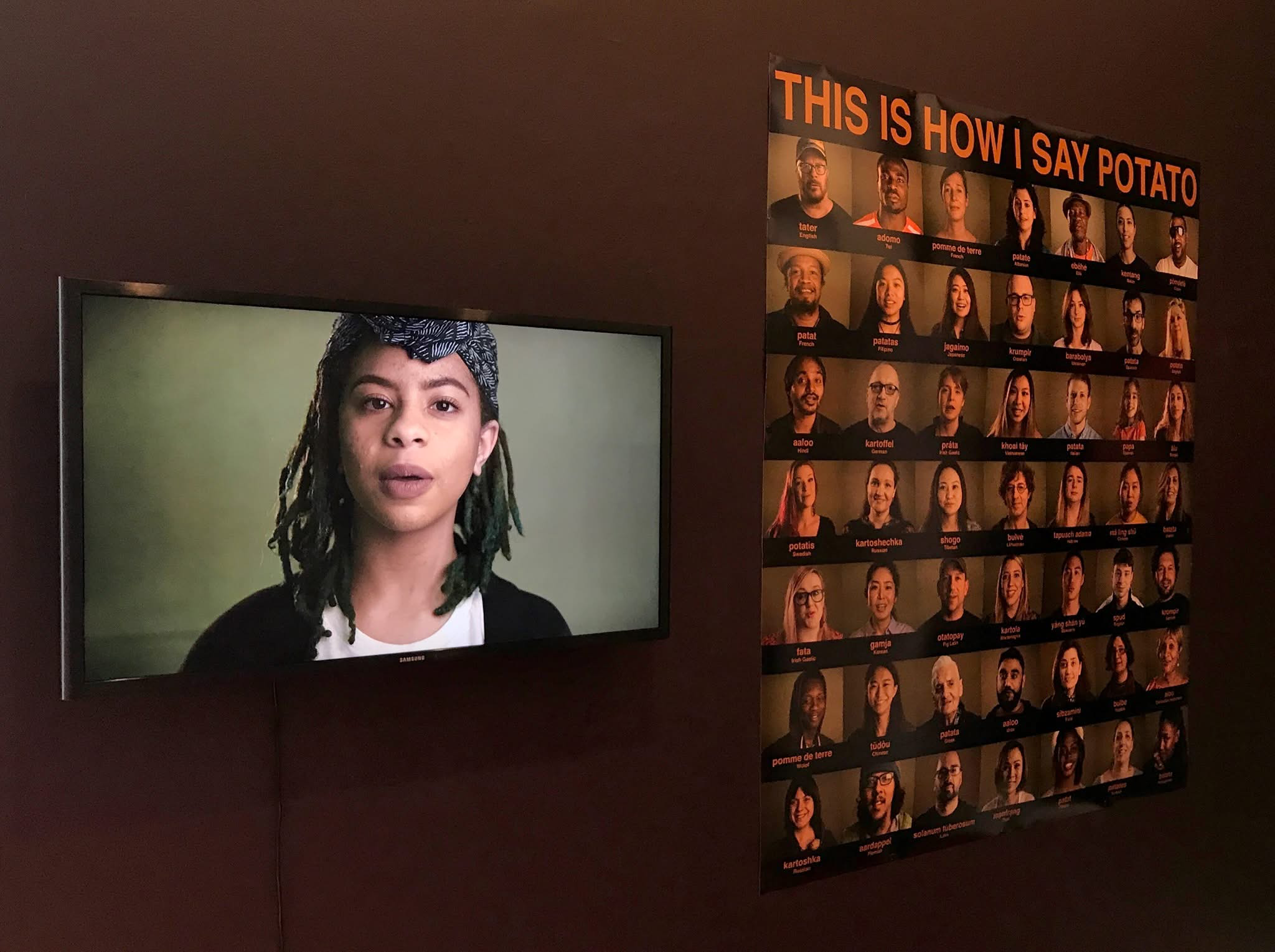
THIS IS HOW I SAY POTATO film and poster on view at the Islip Art Museum, 2019. Photo courtesy Jeffrey Allen Price. The Art of Collaboration curated by Holly Gordon
ISLIP ART MUSEUM
at Brookwood Hall, 50 Irish Lane, East Islip, NY 11730
On view thru August 24, 2019.
Museum hours:
Tuesday through Friday 10am – 4pm
Saturday 12pm – 4pm
Closed Sunday and Monday
Related Projects:
→ THIS IS HOW I SAY POTATO (2016–Present)
Related Timeline Entry:
-
POTATOISM on the “Dream a Little Dream” Podcast
I was featured on Episode 45 of the Dream a Little Dream podcast, hosted by Jessie Taylor. Titled Through The Eyes Of The Potato, the hour-long conversation explored potato art, POTATOISM, the Think Potato Institute, collecting, exhibitions, and the cultural life of the potato.
Special thanks to Jessie Taylor for the thoughtful conversation and for helping spread the potato message.
You can listen to the episode here: https://player.fm/series/dream-a-little-dream?v=1781570281
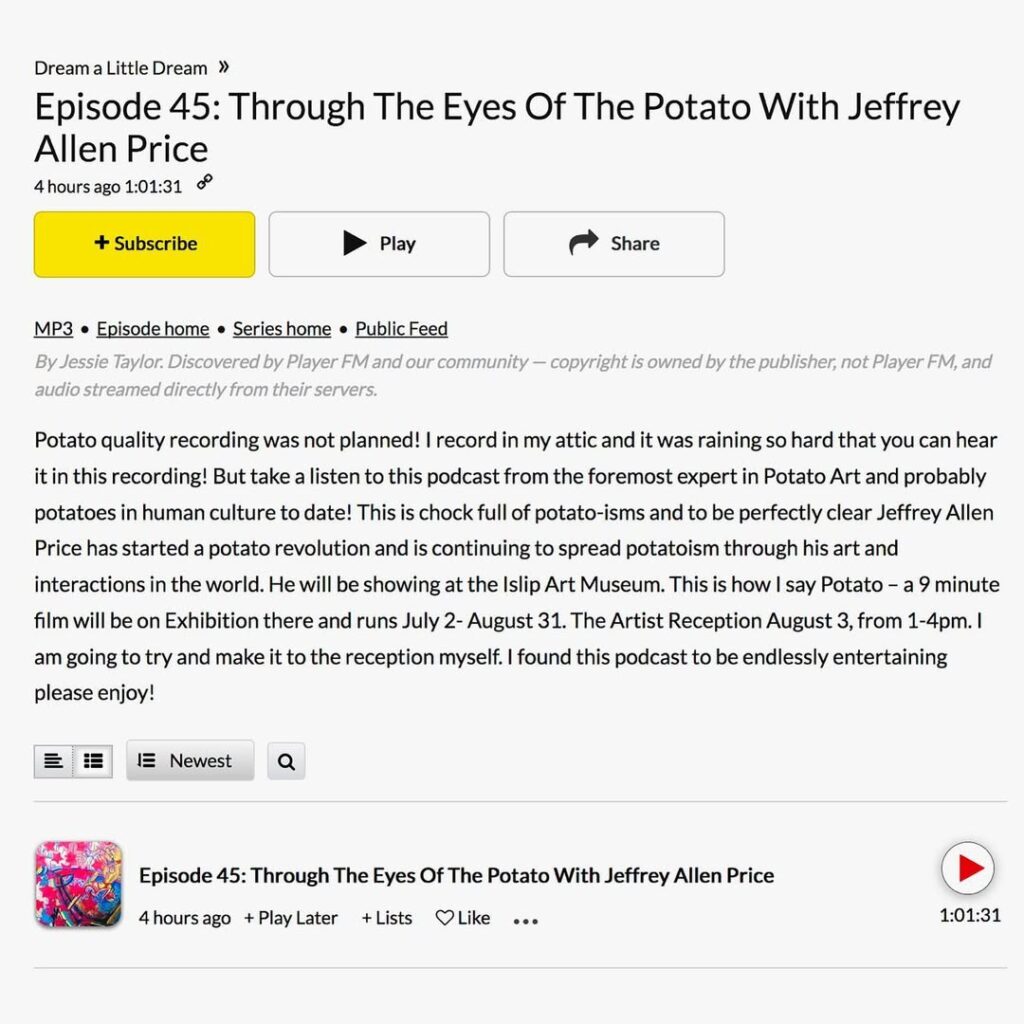
Update: The podcast is no longer actively maintained and the original audio is currently unavailable. Fortunately, this screenshot survives as documentation of the episode’s existence and release.
-
The Exhibition Ends, the Archive Begins
Today I dismantled my JamaicaFlux installations after a rewarding three-month run. I am deeply grateful to curator Heng-Gil Han for the opportunity to participate and for producing such an outstanding catalog documenting the exhibition. Shown here are the eight pages dedicated to my projects, along with the catalog cover and expanded flaps.
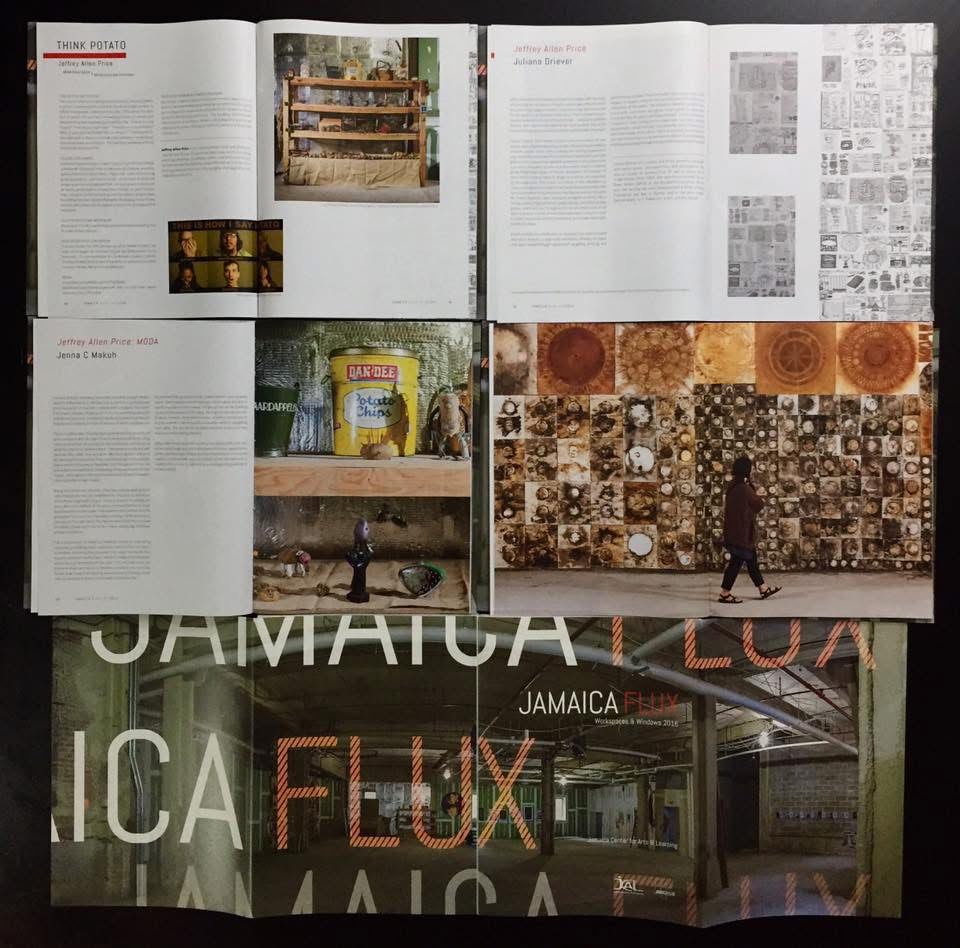
Congratulations to all of the artists who participated. It was a pleasure getting to know your work and to see the remarkable range of projects represented in the publication.
Special thanks to Juan López Espantaleón and Dom Sindayiganza, whose photographs greatly enhanced the presentation of my work in the catalog. I would also like to thank co-curator Kalia Brooks and the Jamaica Center for Arts and Learning for their support, generosity, and commitment to making Jamaica Flux such a meaningful experience.
While the installations have now been dismantled, the ideas, relationships, documentation, and projects that emerged from the residency continue to grow.
-
100 Participants and Counting
THIS IS HOW I SAY POTATO at-home filming progress. We are nearly complete with our film’s first flagship segments SAYing, SINGing, SCEAMing Potato in different languages and accents from around the world.
Today Juan and I filmed each other and our families for THIS IS HOW I SAY POTATO and surpassed the 100 participants benchmark.
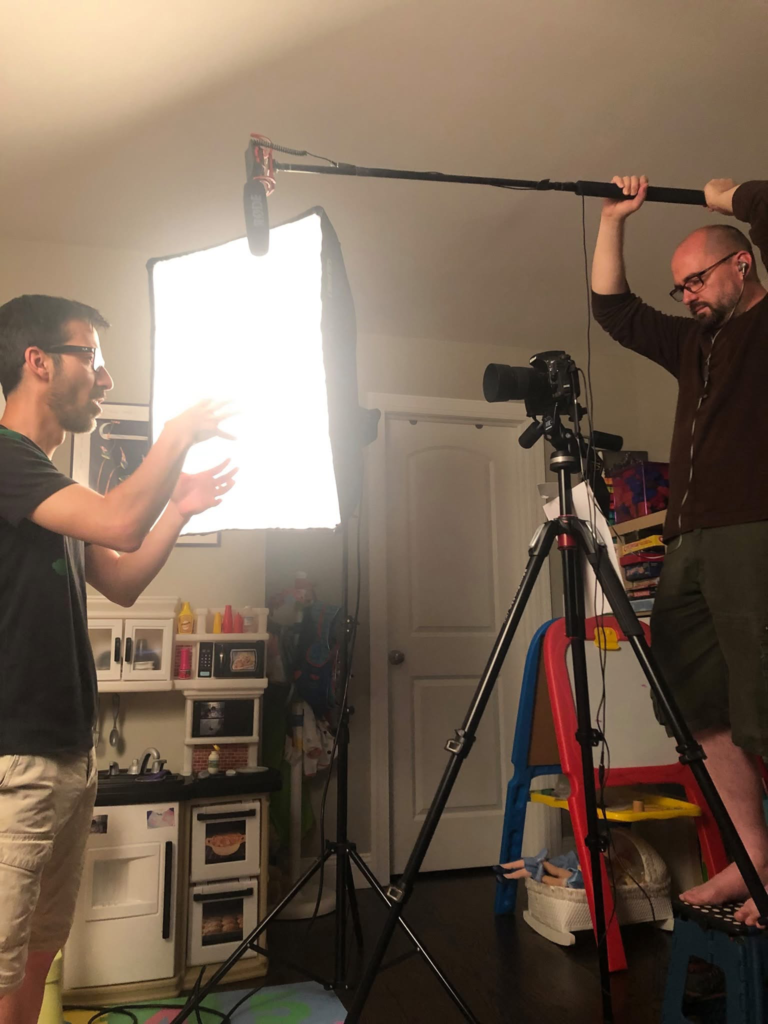
Jeffrey Allen Price and Juan López Espantaleón filming one another during a 2019 recording session after surpassing 100 participants in the project.
Related Projects:
→ THIS IS HOW I SAY POTATO (2016–Present)
Related Timeline Entry:
→ THIS IS HOW I SAY POTATO 2016 – TPI Timeline Entry
Film Coverage:
2025 — The Spud Has Its Day in the Sun — The East Hampton Star
2024 — MainPotRe during Vidzeme Innovation Week 2024— Interreg Baltic Sea Region
2019 — The Art of Collaboration — The Islip Bulletin [PDF]
Project Archive:
-
We Always Learn Something New About Potatoes
We always learn something new about potatoes when we film.
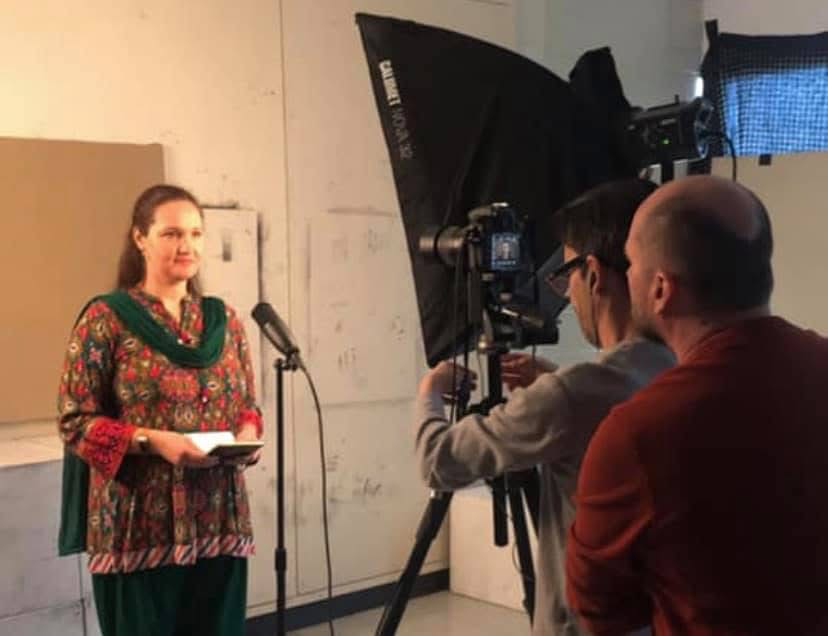
Filming Anna Prikazchikova at Suffolk County Community College. Photo courtesy Camila De La Pava. During a recording session for THIS IS HOW I SAY POTATO at Suffolk County Community College, participants shared potato folk remedies and traditions from around the world. We heard about using the steam from boiling potatoes to help relieve colds (Russia), potato slices for skincare and facial treatments (Jordan), and even potatoes reportedly used as diaphragms for birth control (Colombia).
It was a fun and productive day of filming with participants from Russia, Pakistan, Colombia, Jordan, Turkey, Germany, and the United States. Every recording session added new stories, new languages, and new perspectives to the growing archive.
Thanks to everyone who participated and to Camila De La Pava for the photograph.
Related Projects:
→ THIS IS HOW I SAY POTATO (2016–Present)
Related Timeline Entry:
→ THIS IS HOW I SAY POTATO 2016 – TPI Timeline Entry
Project Archive:
-
Seeking New Ways to Say Potato
I am excited to announce that we will be filming again for THIS IS HOW I SAY POTATO during select times in conjunction with the “POTASIA: Potatoism in the East” exhibition at The Charles B. Wang Center at Stony Brook University (thru June 15, 2018). First day of filming is March 30 (Good Friday) from 11am-3pm. Please schedule an appointment if you would like to participate. We are giving priority to languages and dialects we have not recorded yet, but anyone with a sense of humor or a love of potatoes will be considered. We are still looking to interview people that speak German, Dutch, Italian, Arabic, Thai, and many Asian and African languages.
If you would like to participate please contact info@thinkpotatoinstitute.org.
Related Projects:
→ THIS IS HOW I SAY POTATO (2016–Present)
Related Timeline Entry:
→ THIS IS HOW I SAY POTATO 2016 – TPI Timeline Entry
Project Archive:
→ Official Facebook Page for THIS IS HOW I SAY POTATO
-
POTATO Fashionista
Wonderful seeing The Stylegazer fashion blogger Nina Vasiljević rockin’ the Classic THINK POTATO Tee!
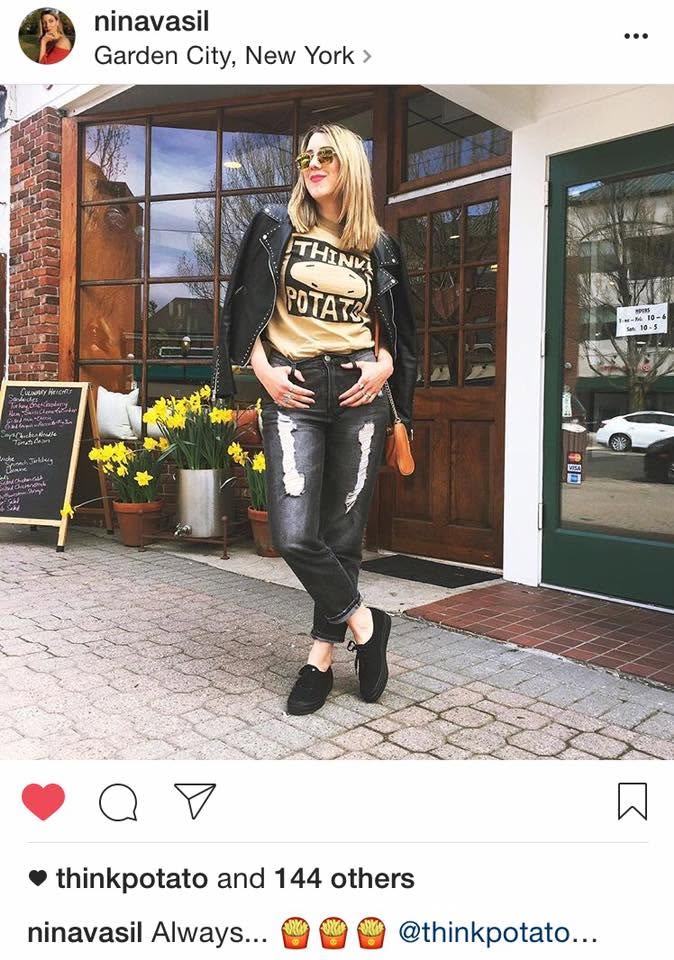
Here’s a link to her post on IG if you want to tell her how great the look is!
-
Potato TV Sampler (2003)
Montage of Potato-themed events and performances from Jeffrey Allen Price ca.1996-2003
Created in 2003, this video predates YouTube and many of the social media platforms that would later become common places for sharing short-form video, and before the Think Potato Institute officially existed, I assembled this “Potato TV Sampler” for the Tom Green Show. (I was asked by the producer to submit a reel for possible guest appearance on the show). The video is a chaotic montage of potato-themed performances, festivals, music, games, and experiments spanning roughly 1996–2003.
Background music by J.A.P. and the Blues Spuds band covering Neil Young’s “T-bone” (Got mashed potatoes/ain’t got no t-bone). Features segments include:
“Potato Gun Shot from 5 Feet”, 2003
“I Like Potato and Potato Likes Me”, 2003
“Potato Stratego”, 2003
“POTATOLAB”, 2002
“Emergency PotatoFete”, 2001
“Think Potato Festivals II and III, 1998-99”
and more. -
Hyperallergic Reviews Dennis Oppenheim Homage Exhibition
Potato Auto-Portrait (2004) at Valentine Gallery May 24, 2014
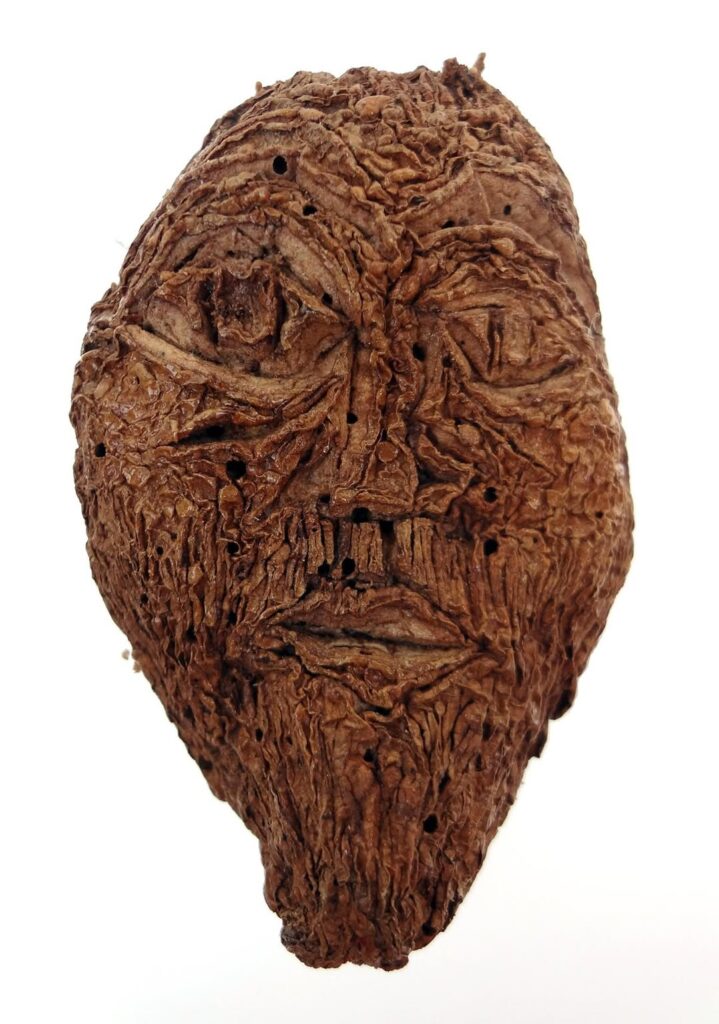
“Potato Auto-Portrait (carved in 2004-photo taken November 28, 2012)”
dried potato
dim. var. approx. 3 x 2 x 1.25 inches
©Jeffrey Allen PriceMy sculpture Potato Auto-Portrait was included in a review of the Dennis Oppenheim homage exhibition published by Hyperallergic.
The reviewer wrote:
“There is a third self-portrait in the show, along with Becket’s and Oppenheim’s, by Jeffrey Allen Price. A former assistant to Oppenheim, Price made his comic-Picassoid ‘Potato Auto-Portrait’ (carved in 2004), as the title states, ten years ago, and it has been shrinking ever since; consequently, this piece is also moving, albeit at a glacial pace.”
One of the stranger qualities of working with potatoes as an artistic medium is that the artwork continues to transform long after it is completed.
Read the full review here:
Homage to Absurdity: The Restless Legacy of Dennis Oppenheim— Hyperallergic
-
Reflections on Open Feast: Potato Potluck
Many thanks to Irina Zadov and Abraham Epton for making Long Island the final stop on their remarkable cross-country Open Feast journey. It was a pleasure to share stories, potatoes, and conversation with such generous travelers and new friends.
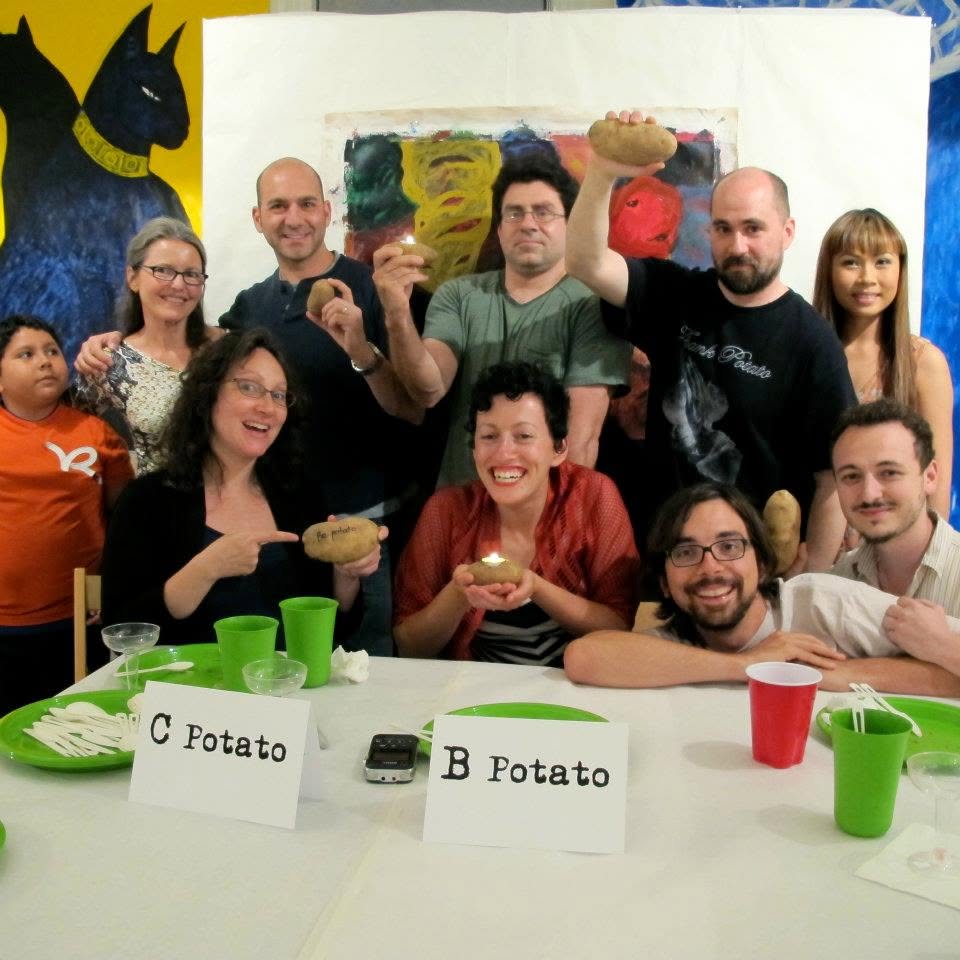
Special thanks as well to Viviane Le Courtois for helping connect our potato worlds and inspiring another communal potato gathering.
As Irina taught us, the potato is known in Belarus as бульба (bul’ba), a word that seems particularly fitting after an evening spent celebrating food, friendship, and cultural exchange around a shared table.
Wishing Irina and Abraham safe travels on their next adventures in Belarus and beyond. Grateful that Open Feast inspired another memorable Occupy Potato event and many new connections.
Peace, love, and potatoes.
Explore More:
-
Potato Potluck with Open Feast
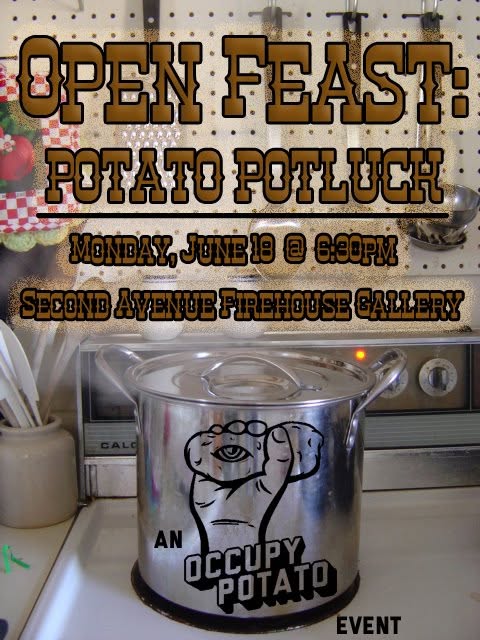
You are invited to join us for Open Feast: Potato Potluck at the Second Avenue Fire House Gallery in Bayshore on Monday, June 18 at 6:30pm. Artists Irina Zadov and Abraham Epton have driven coast to coast, sharing dinner and stories along the way as part of their Open Feast project. Ryan Seslow and myself are happy to host the final dinner of the tour at our exhibition CO-ACTIVATE at the Gallery. Please RSVP if you are coming. Bring something potato!
Explore More:
→ Open Feast: Potato Potluck (2012)
→ Institute Chronicle: Reflections on Open Feast: Potato Potluck
-
The Potato Revolution Exhibition-Mash-Up
I produced this short video following the opening of The Potato Revolution: Cult of Potato 2011 at the Williamsburg Art & Historical Center (WAH Center) in Brooklyn, New York. The video combines footage from the exhibition with scenes from The Potato Revolution Café, an installation that features over a thousand objects from my growing potato collection.
The soundtrack features the song “Viva La Potato Revolution,” performed by my band POTATOTRON which seemed like the perfect accompaniment to the project. I like this video because it captures some of the energy and enthusiasm surrounding the exhibition in a way that photographs alone cannot.
Special thanks to Nimajus Bagdonavicius for his help filming and editing during the opening events.
Related Exhibitions:
-
“ARE YA LEARNIN’ SOMETHING?”
Meyer Segal was the first documented visitor to the TPI Riverhead Temporary Headquarters today.
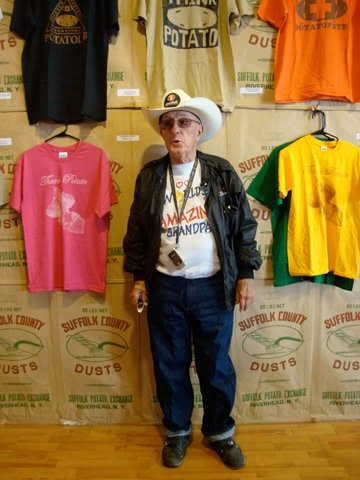
A lifelong East End resident, Meyer is 88 years old and seemed to know the entire history of Riverhead—as well as nearly everyone who lived there. During his visit, he shared stories about the local community, the potato industry, and his own experiences selling potato sacks many years earlier, not unlike the historic examples displayed on the walls of TPI.
Meyer had plenty of enthusiasm, plenty of opinions, and plenty of advice. Throughout our conversation he repeatedly asked:
“Are ya learnin’ something!?”
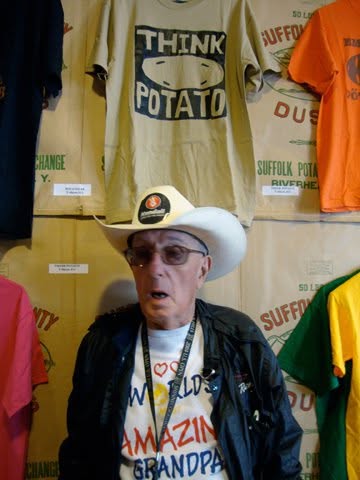
The question was both humorous and sincere. I loved it. I think it captures something essential about the spirit of the Think Potato Institute. TPI has only just now opened its doors, but already the project is doing exactly what it was intended to do—bringing people together to share stories, knowledge, memories, and ideas through the humble potato.
Thank you, Meyer.
Related Exhibition:
-
TPI Opens This Weekend
Very excited to unveil my THINK POTATO INSTITUTE this weekend in Riverhead, NY during the Harvest Festival. On view, 15 years of collecting potato-themed art and artifacts from around the world, with some of my own potato art also on display. Sat. & Sun. 10/9-10/10, 10am-4pm, with a Reception and Artist Talk Sat. 10/16 from 2-4pm. Located at 127 E. Main St. Riverhead, NY.
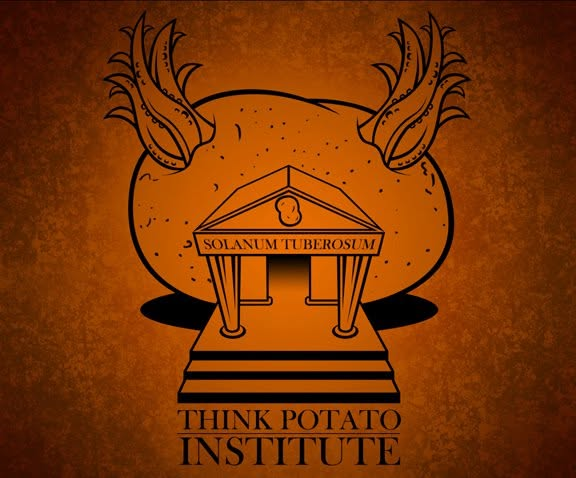
New THINK POTATO INSTITUTE logo, 2010. -
Resident Potato
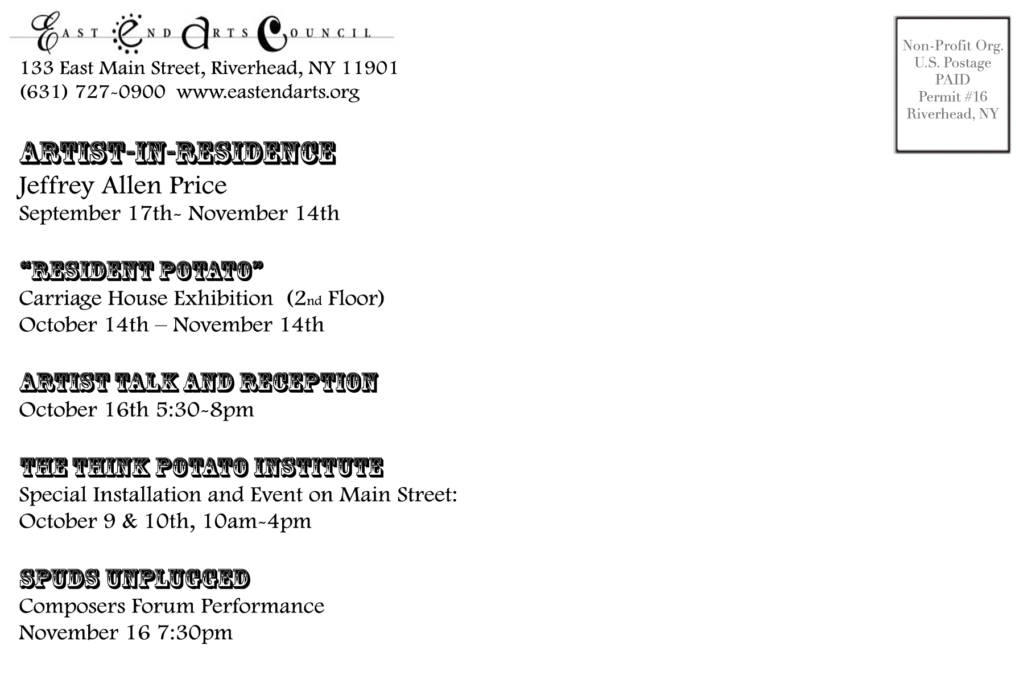
Today I am beginning my two-month Artist-in-Residence program at the East End Arts Council in Riverhead, New York.
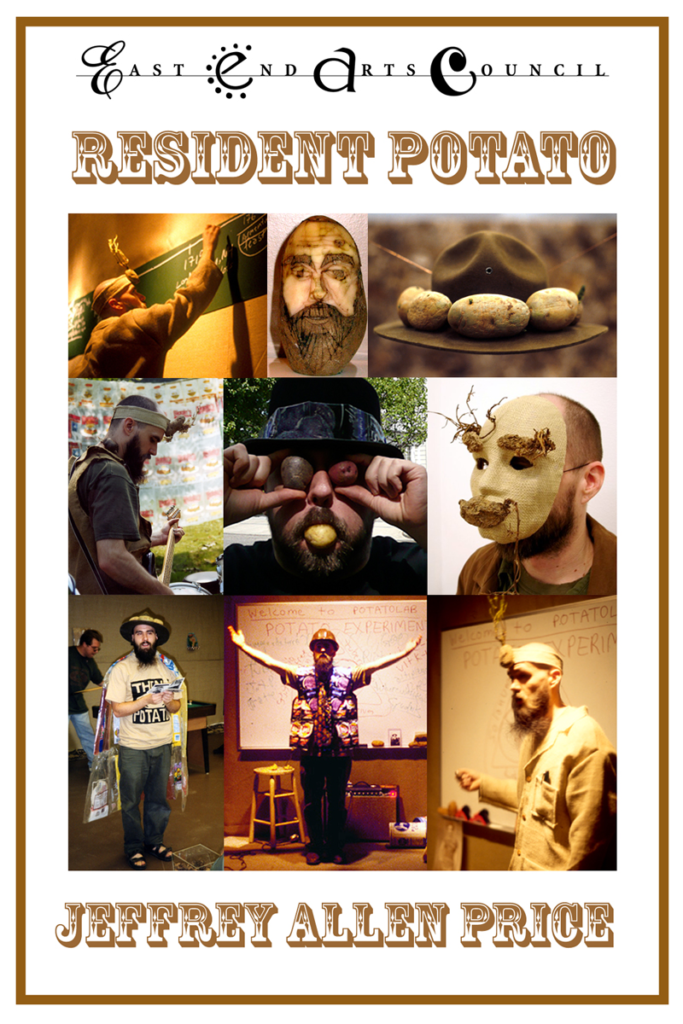
Over the next several weeks I will be presenting a number of potato-related projects, including Resident Potato, an exhibition in the Carriage House Gallery; Spuds Unplugged, a performance for the Composers Forum; and an Artist Talk and Reception.
Most exciting of all, I will be unveiling The THINK POTATO INSTITUTE on Main Street in three weeks. For two days in October, a vacant storefront in downtown Riverhead will be transformed into a temporary headquarters for TPI.
I am now officially a Resident Potato.
Please stop in if you are in the neighborhood and say hello.
ARTIST-IN-RESIDENCE
Jeffrey Allen Price
September 17th – November 14th“RESIDENT POTATO”
Carriage House Exhibition (2nd Floor)
October 14th – November 14thARTIST TALK AND RECEPTION
October 16th
5:30–8:00 PMTHE THINK POTATO INSTITUTE
Special Installation and Event on Main Street
October 9th & 10th
10:00 AM–4:00 PMSPUDS UNPLUGGED
Composers Forum Performance
November 16th
7:30 PM
East End Arts Council, 133 East Main Street, Riverhead, NY 11901
Related Exhibition:
-
Potato Excuses I & II (2004)
I am full of excuses. Here’s a couple of good ones in a 51 second video from 2004. “My Plate is Full!,” and “I’ve Bitten Off More Than I Can Chew!”
-
The Dialectical Potato Accepted for Publication (2002)
Entering my last semester of graduate work at Stony Brook University, I have just received encouraging news: my paper, The Dialectical Potato: Potato in Art, Art in Potato, has been accepted for publication in Art Criticism thanks to the auspices of Professor Donald Kuspit.
The paper began with a simple question that had occupied my thoughts for years: Why do potatoes keep appearing in art, and what do these appearances mean? What started as an attempt to chronicle the major appearances of the potato in the work of avant-garde artists gradually expanded into a much larger investigation. The more I researched, the more connections I discovered. Potatoes seemed to emerge everywhere—in mythology, folklore, religion, agriculture, conceptual art, performance, photography, politics, and popular culture. What many people dismiss as an ordinary vegetable increasingly appeared to me as a surprisingly rich cultural symbol.
For months I immersed myself in the writings of artists, critics, philosophers, anthropologists, and cultural theorists. Ideas from many different disciplines seemed to converge and inform my subject.
Admittedly, I was a bit nervous presenting such an unconventional topic to my professor, the art critic Donald Kuspit, but his response was enthusiastic. He described the paper as “unique and brilliant,” comments that have encouraged me tremendously. Although many people might consider the potato an unusual subject or symbol for serious inquiry, Kuspit’s remarks make me feel vindicated in pursuing the project. Three semesters studying with Kuspit and engaging the thinkers he introduced undoubtedly helped shape this text.
The acceptance of The Dialectical Potato in Art Criticism makes me genuinely excited. I put a great deal of effort and creativity into this research, and publication feels like an important milestone. The paper grew out of years of looking at artists such as Vincent van Gogh, Joan Miró, Joseph Beuys, Sigmar Polke, Jörg Immendorff, Matthew Barney, and many others. What began as a simple observation developed into a broader investigation of the potato as a recurring image, object, and symbol within art and culture.
The acceptance of this paper by a reputable academic journal gives me confidence to continue pursuing these ideas. For now, I am simply excited to see the article in print and curious to discover where this line of research leads.
Related Timeline Entry:
Related Documentation:
-
Spuds Unwrapped
The Food Network, Television Appearance, April 21, 2002
Tonight I appeared on Food Network’s Unwrapped as part of a special potato-themed episode called Spuds Unwrapped. Seeing myself on national television talking about potatoes and performing was surreal. Host Marc Summers introduced me as a “Potato Artist” and called me “the potato’s number one fan.”
The segment featured an installation of my potato collection, potato-themed artworks, and documentation from EMERGENCY PÖTATOFÊTE, a performance organized with fellow graduate students at Stony Brook University. The event had originally been scheduled around a planned Food Network visit in September 2001. Following the events of September 11, it was unclear whether the production would continue at all. The title EMERGENCY PÖTATOFÊTE reflected both that uncertainty and my belief that gathering people together through food, humor, and art felt especially important during that difficult moment.
During the interview I talked about some of the reasons why I originally became interested in the potato, explaining:
“I started finding all sorts of connections, anthropological connections, all around the world, folklore dealing with the potato. The global significance of the potato became something for me that I could attach to.”
I also explained one of my favorite concepts:
“The potato seems to be this unifying symbol of egalitarianism. I don’t know anyone who doesn’t eat potatoes.”
The segment ended with Marc Summers holding one of the THINK POTATO t-shirts I had given him and saying:
“Here’s one of Jeffrey’s works of art. Looks pretty cool.”
Which made me laugh. Hopefully it might even lead to a few more sales of my potato t-shirt designs online.
The potato continues to drive me and delight audiences. It has introduced me to people I never would have met, conversations I never would have had, and opportunities I never could have predicted. Tonight’s television appearance feels like the latest chapter in an ongoing project that keeps growing in unexpected directions. What began as a curiosity has somehow become a nationwide conversation
Related Timeline Entry:
→ Featured on Food Network’s Spuds Unwrapped (2002)
Related Exhibitions:
→ POTATOLAB (2002)
→ EMERGENCY PÖTATOFÊTE (2001)
